
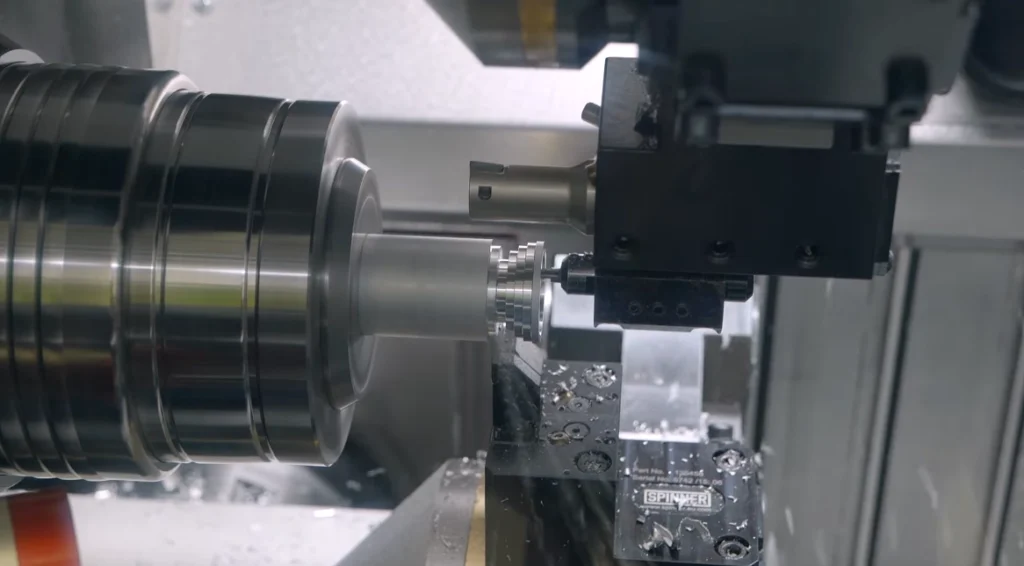
When does it make financial sense to replace multiple single-turret lathes with one multi-spindle, multi-turret turning center?
The crossover point typically comes when labor, floor space, or inter-operation queue time is costing more than the price premium of the machine. A 3-turret, 2-spindle turning center can consolidate what would otherwise require 2–3 machines and 2–3 operators into a single setup run by one person while cutting cycle times by 40–50%.
The ROI case gets stronger when your parts require secondary operations (milling, drilling, back-work), when you’re targeting lights-out production, or when you’re bidding on complex, higher-margin work and losing on cycle time.
Why Shops Should Move from Single Turret CNC Lathes to Multi-Turret CNC Turning Centers
You already know you can’t just “add an operator.” The shops that have figured out how to grow capacity without growing headcount aren’t running harder, they’re running machines with more tools in the cut at any given moment. Multi-spindle, multi-turret turning centers are how they’re doing it, and the economics are harder to ignore every year.
This isn’t a pitch for complex multi-tasking equipment. It’s a straightforward look at what a 3-turret, 2-spindle machine actually does to your cycle times, your cost per component, your floor space, and your ability to win work the shop down the street can’t touch.
The Simple Math of More Tools in the Cut
Strip away everything else and the argument for multi-turret turning comes down to overlap. Every second that a turret is cutting while another turret is also cutting is a second you don’t pay for twice. More tools in the cut simultaneously means faster cycle times – not incrementally faster, but dramatically faster.
A third turret instantly gives you the ability to run 3 tools simultaneously. When an application is optimized to take full advantage of that overlap, the results aren’t modest. Consider what happens to a real aerospace part when you move it from a conventional 2-turret machine to a 3-turret platform: they originally quoted 274 seconds. The optimized 3-turret cycle came in at 144 seconds – nearly 130 seconds faster per part, on the same bar stock, same material, same tolerances.
Cycle time comparison: conventional 2-turret vs. optimized 3-turret lathe (WestWind Air Bearing example)
| Configuration | Cycle Time | Time Saved Per Part | Annual Parts @ 1 shift |
|---|---|---|---|
| 2-Turret (conventional) | 274 sec | — | ~105,000 |
| 3-Turret (optimized) | 144 sec | 130 sec (47%) | ~200,000 |
The floor space math is equally compelling. A third turret adds 50% more processing power to the same machine footprint. Every square foot of your building carries overhead – heat, light, insurance, maintenance staff – that gets baked into the cost of every part you make. Increasing machine output without increasing floor space is one of the few genuine levers you have on fixed overhead costs.
What A Multi-Turret Machine Actually Unlocks
The headline benefit is cycle time reduction, but the deeper value is what becomes possible when you have three independent turrets to work with. Operations that used to require a second machine, or a creative workaround, become straightforward.
Pinch Turning
Two turning tools applied from opposing directions simultaneously. The forces balance each other out, stabilizing the part against deflection which means you can rough cut aggressively without the part walking. You can also rough and finish in a single pass, or run two roughing tools at the same time and split tool wear across both, extending life while removing material faster.
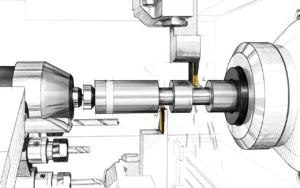
Pinch Milling
The same logic applied to milling operations. Two milling tools working opposing faces of a part doubles your metal removal rate and keeps cutting forces balanced. Generating hex features from round stock, something that drives shops to expensive pre-cut hex bar, becomes fast and economical without the material premium.
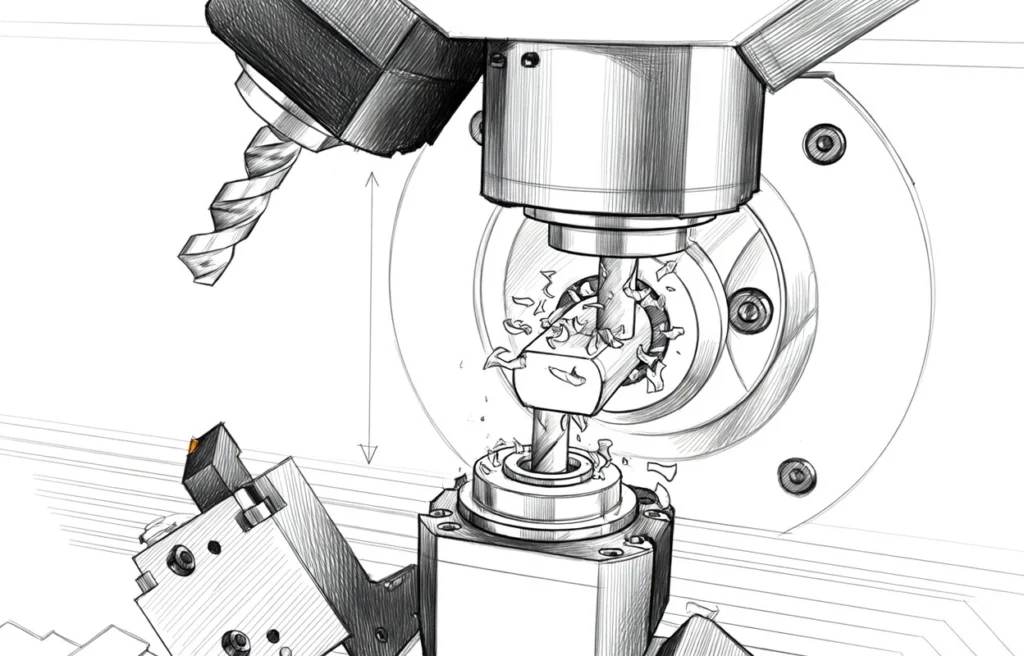
Dual-Process Drilling
With turrets capable of serving either spindle, drilling and tapping operations on the main spindle and second spindle can run simultaneously rather than sequentially. On parts with significant back-working complexity, this alone can cut the effective cycle time substantially.
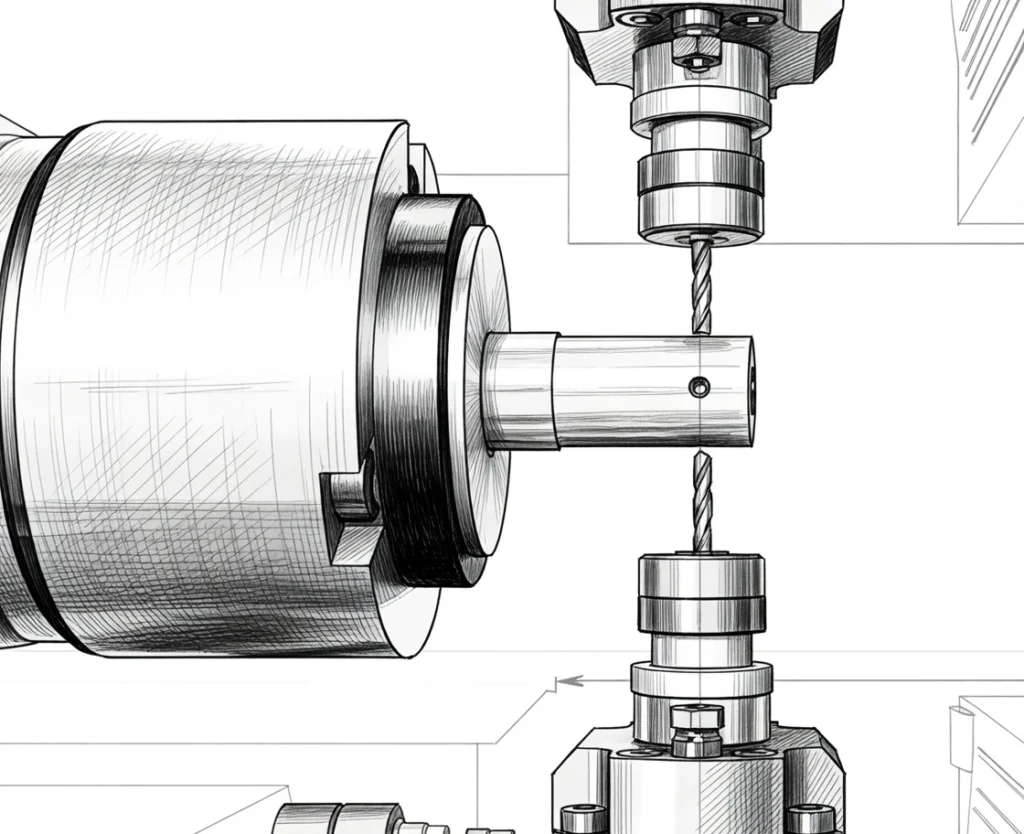
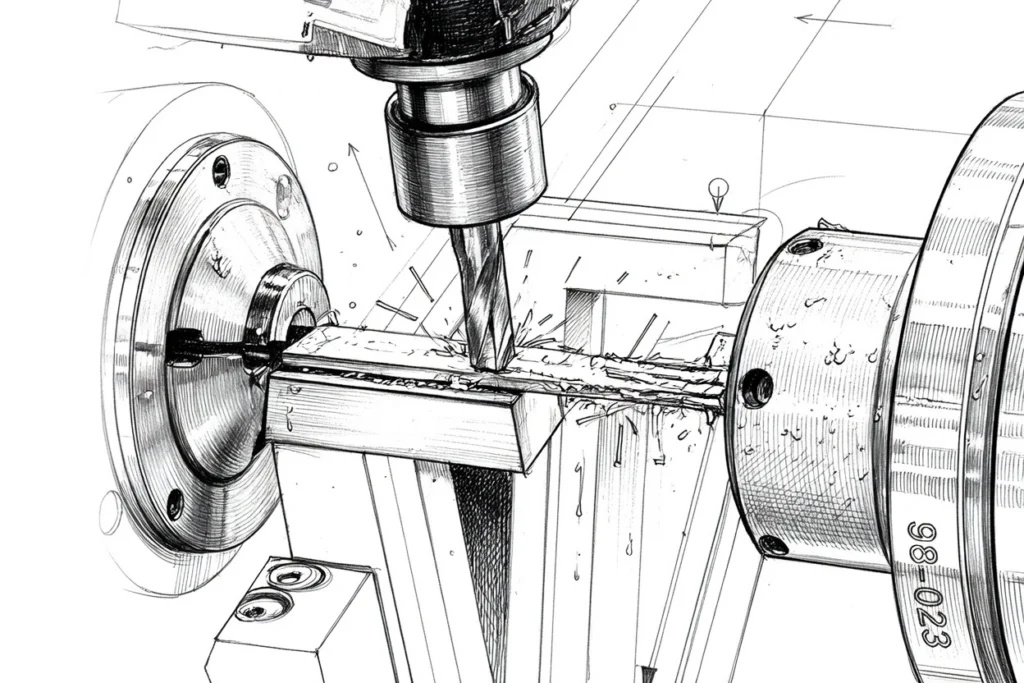
Part Support
When a feature requires support to maintain tolerance or surface finish, a support block can be moved in to eliminate part flex during the machining process. Using this technique can also allow more aggressive material removal while maintaining the finished part requirements.
| Capability | 1 Turret | 2 Turrets | 3 Turrets |
|---|---|---|---|
| Tools in cut simultaneously | 1 | 2 | 3 |
| Pinch turning / pinch milling | No | Possible | Full flexibility |
| Simultaneous front + back work | No | Possible | Full flexibility |
| Complex back-working without compromise | No | Limited | Yes |
| Rough + finish simultaneously | No | Limited | Yes |
| Redundant resident tooling | Minimal | Some | Up to 36+ stations |
| Elimination of secondary ops | Rare | Partial | Frequent |
The third turret also changes how programmers attack part complexity. With only one or two turrets, you’re constantly making tradeoffs… which features can I reach from the front? What do I sacrifice on the back?
A third turret gives programmers the freedom to choose whether to work front-to-back or back-to-front, and to assign complex back-working operations without compromising front-side cycle time.
Addressing the CNC Programming Complexity Concern
The most common objection from experienced machinists isn’t about cycle time, it’s about programming. Managing turret synchronization, wait codes, and spindle handoffs across three axes simultaneously sounds daunting, and there’s a real learning curve. But the tools available today make that curve far less steep than it was even five years ago.
CAM packages like GibbsCam, Esprit, and Siemens NX have multi-turret simulation built in, rendering the program in full 3D before a single chip is cut. Collision detection is automated. Sync logic is visual.
The real risk isn’t programming complexity – it’s optimizing the program.
A poorly synchronized 3-turret program can run slower than a well-written 2-turret program if wait codes aren’t managed carefully. This is why machine builders worth working with offer applications engineering support and will prove out your specific part.
Vibration, Harmonics, and the Passive Dampening Advantage
Running three turrets simultaneously, especially when one is roughing aggressively while another is finishing, creates a real challenge with harmonics. Interrupted cuts, threading, and heavy milling operations all generate vibration that doesn’t just stay in one turret. On a machine that isn’t designed to handle it, that vibration walks into your finish pass and shows up as surface finish problems, accelerated tool wear, or worse.
The traditional response from machine builders has been to add mass – more cast iron, more weight, more girth. That helps, but it doesn’t solve the problem elegantly, and it does nothing for the dwell time you’d otherwise need to program between a roughing operation and the finish pass that follows.
Spinner’s approach is passive vibration dampening built into each turret. The practical result is that you can rough on one spindle while finishing on the other simultaneously, without waiting for vibration to settle. The benefits compound across the program:
| Without Passive Dampening | With Passive Dampening (Spinner) |
|---|---|
| Programmed dwells required between rough and finish | Rough and finish run simultaneously |
| Conservative depth of cut to protect finish quality | More aggressive cuts without surface penalty |
| Reduced tool life from harmonic fatigue | Extended tool life |
| Surface finish problems on adjacent ops | Improved, consistent surface finish |
Chip Management and the Path to Lights-Out Efficiency

Three turrets generating chips simultaneously is a lot of chips. On a poorly designed machine, they pile up in every corner, eventually interfering with axis travel, contaminating coolant, and giving you a reason to keep someone nearby rather than running unattended. Lights-out manufacturing is only as reliable as the weakest point in the process, and chip management is frequently that point.
Spinner addressed this with a 90-degree slant bed so chips fall straight away from the cutting zone by gravity alone, onto a huge 24-inch-wide chip conveyor that handles the volume without intervention. It’s not a feature to gloss over. It’s the difference between a machine you can trust to run overnight and one that needs babysitting.
The 90-degree bed also has an ergonomic payoff: tools sit directly in front of the operator at a natural working height, which makes changeovers faster and easier and reduces the exertion that accumulates over a full shift of setup work.
Setup, Resident Tooling, and the High-Mix Advantage
The perception that multi-turret turning only pays off for high-volume shops running the same part around the clock is worth examining directly. It’s wrong, and it misses one of the most powerful features of a 3-turret platform which is station count.
With three turrets at 12 stations each, plus the option for double-sided holders, you’re looking at 36 or more tool positions on a single machine. That isn’t just capacity for a complex part. It’s enough to keep entire families of parts permanently resident, with tooling never pulled between runs.
Setup time comparison: traditional approach vs. resident tooling strategy
| Scenario | Traditional Single-Turret | 3-Turret with Resident Tooling |
|---|---|---|
| Job changeover | Full tool pull and reset90–180 min typical | Program swap + offset verify15–30 min typical |
| Tools for a 5-part family | Sequential, pulled between jobs | All resident simultaneously |
| Redundant tools for long runs | No capacity | Built in – automatic switchover |
| Unattended run risk | High (tool wear stops the machine) | Low (backup tool takes over) |
Quick-change collet systems like from Hainbuch extend this advantage to the workholding side. Collet and chuck changes that used to take 20–30 minutes with conventional workholding come down to a few minutes, compressing the non-cutting time that often accounts for more of the total part cost than the cutting cycle itself.
Making the ROI Case for Multi-Turret Lathes
The sticker price on a high-end multi-spindle, multi-turret turning center is real. So is the cost structure of the alternative. Let’s look at the numbers honestly.
| Cost Element | 2 × Single-Turret Setup | 1 × 3-Turret Turning Center |
|---|---|---|
| Operators required | 1-2 | 1 |
| Floor space | 2× footprint | 1× footprint |
| Secondary operation machines | Often 1–2 additional | Eliminated or reduced |
| Inter-op queue time | Hours to days | Zero |
| Part handling / risk of damage | Multiple transfer events | One setup, done |
| Machine cost per part (illustrative) | ~$2.25 | ~$0.77 |
| Total cost per part (illustrative) | ~$6.00 | ~$3.27 |
The total cost figures above come from an aerospace application study. Your numbers will vary by shop rate, part complexity, and material – which is exactly why time-and-cost studies on your specific parts exist. Any machine builder making an honest case will run one before asking you to commit.
The capacity argument often closes the deal even when the per-part cost math is close. A single 3-turret machine running two shifts delivers roughly 300% of the capacity of a conventional 2-turret machine in the same floor space. That’s the room to take on more work without a building expansion, a new hire, or a new lease on additional machines.
And when you add automation – a bar feeder, a robotic load/unload system, or both – the equation shifts again. The operator who was running that second-op machine is now free to run a second cell, handle quality inspection, or manage the setup work that keeps the automated machine in cycle. You’re not replacing people. You’re getting more value from the ones you have.
Frequently Asked Questions
Questions we hear from production managers and shop owners evaluating multi-turret turning – answered directly.
Our cycle times are already competitive. Can a multi-turret machine still move the needle?
Spindle-on time is rarely the whole story. Queue time between operations, operator handling, and second-op setups often add more to total part cost than the cutting cycle itself.
A 3-turret machine can eliminate secondary operations entirely by completing front and back work in a single setup – which means the gains show up in throughput and floor capacity, even if your raw cycle time looks strong already. Ask yourself how long does a finished part actually sit between operations before it ships?
We run high-mix, low-volume work. Is multi-turret turning worth it if we’re not running the same part all day?
This is exactly where resident tooling changes the math. With 36 tool stations across 3 turrets, plus double-sided holders, you can keep tooling loaded for entire families of parts and never pull it between runs. Changeover becomes a program swap and offset verify rather than a full tool rebuild. High-mix shops that make this shift typically find they can serve 3–5 part families off the same machine with dramatically reduced changeover time, turning what looked like a liability into a competitive advantage on quick-turn work.
What’s the real programmer learning curve going from a simple 2-axis lathe to a 3-turret machine?
The honest answer is it’s real, but manageable. The core challenge is synchronization – understanding wait codes, spindle handoff timing, and how to balance the turrets so no axis sits idle waiting on another.
CAM packages like GibbsCAM, Esprit and Siemens NX have multi-turret simulation built in, which eliminates the collision anxiety before anything hits metal. Most experienced programmers are writing productive multi-turret programs within weeks, not months, especially with good applications support from the builder.
Can one operator realistically run a multi-turret lathe and additional machines at the same time?
Yes, and this is one of the core ROI drivers. A multi-turret machine with a bar feeder running in cycle requires operator attention primarily at setup and at bar changes. In a well-designed cell with bar-feed or robotic automation, one operator can actively manage 2–3 machines simultaneously.
The operator who was dedicated to a second-op machine gets redeployed to higher-value work. This isn’t a theoretical model – it’s how high-output shops are staffing today, in an environment where finding additional operators is genuinely difficult.
How do I know if my parts are good candidates for multi-turret turning before I commit?
Ask four questions:
- Does the part require back-working or sub-spindle operations?
- Does it currently travel to a second machine for milling, drilling, or threading?
- Is the current cycle time longer than 60 seconds?
- And are you running that part, or a similar family, more than a few hundred pieces per month?
Two or more yes answers usually indicates a strong application. The best next step isn’t guesswork – Spinner’s team will run a time-and-cost study on your specific part at no charge, so you’re evaluating real numbers rather than estimates.
We’ve heard vibration is a real problem when roughing and finishing simultaneously. How serious is it, and how is it managed?
It’s a legitimate concern – interrupted cuts, threading, and heavy milling operations generate harmonics that can contaminate a finish pass on the opposing spindle if the machine isn’t engineered to handle it. The traditional solution was adding mass (more cast iron), which helps but forces programmed dwells between rough and finish operations.
Spinner’s passive vibration dampening system, built into each turret, allows simultaneous rough and finish operations without those dwells = which directly translates to longer tool life, tighter surface finish, and more aggressive allowable cuts.
What happens to throughput if one turret goes down for tooling or an insert change?
The machine keeps cutting. The remaining turrets can often carry the critical operations while the issue is addressed, potentially at a modestly longer cycle time rather than a complete stop. This is a meaningful resilience advantage over running three separate machines, where a single machine failure pulls an entire cell offline. Redundant tooling in a 36-station setup also means a worn insert doesn’t stop a run as a pre-loaded backup tool takes over automatically while the next change is scheduled at a natural break point.
How does a multi-turret lathe compare to a Swiss-type machine for high-volume small-diameter parts?
Swiss machines excel on small-diameter, long-slender parts – typically under 32mm bar stock – where guide bushing support is essential for holding tolerance on length-to-diameter ratios that would deflect in a conventional chuck setup. Multi-turret turning centers cover a broader diameter range, handle heavier cuts, and are significantly more capable on complex back-working and large feature milling.
If your parts are under 1.25″ diameter with tight tolerances on long features, Swiss is worth a serious look. Above that diameter, or with substantial secondary geometry, multi-turret typically wins on flexibility, per-part cost, and the ability to consolidate a wider variety of work onto fewer machines.