
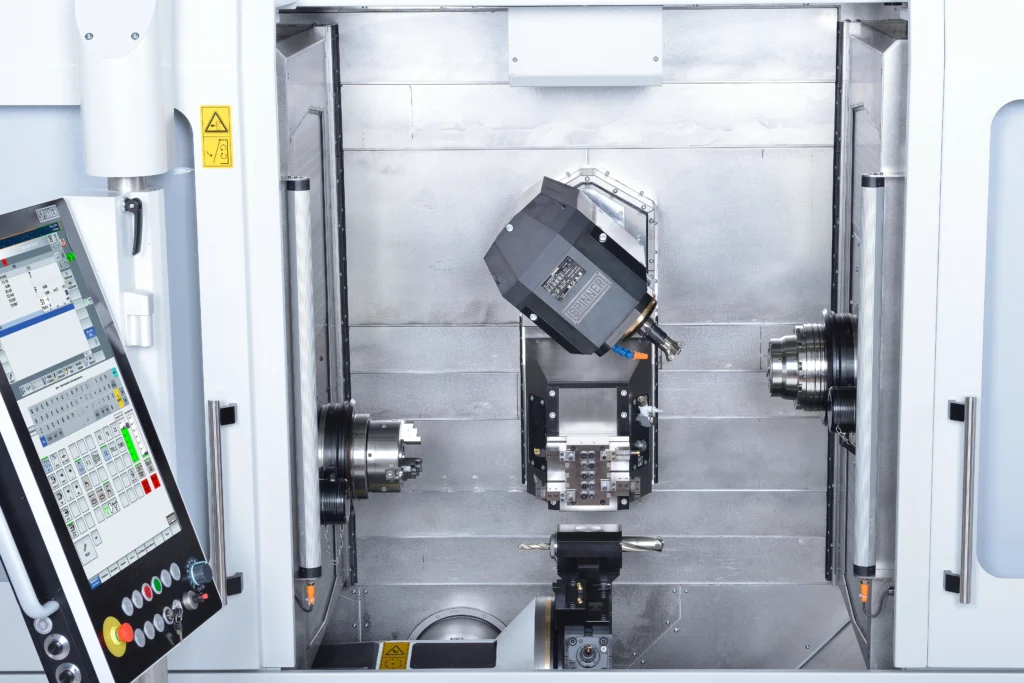
When does a mill turn machine actually make sense over a separate lathe and mill?
The crossover point comes when a part’s turning and milling features can’t be finished economically on either machine alone, or when the part currently travels between two machines and loses accuracy, time, or money on every trip.
A true mill turn center puts a milling spindle, Y-axis travel, and often a second spindle on the same platform as the turning operation, so a part that used to take two or three setups gets finished in one.
The case gets stronger fast when the part needs submicron tolerances or hardened-material turning. And a small number of parts need something different again: turned first, then ground for final accuracy, with no milling involved at all. That’s a distinct machine, not an add-on, and it’s worth knowing the difference before you shop.
CNC Mill Turn Machines: The Complete Guide for Job Shops
If a part on your shop floor spends time on a lathe, then rides over to a mill for a keyway or a cross-hole, then maybe gets boxed up and shipped out for finishing work, you already know what that costs. It’s not just the machine time. It’s the queue between operations, the re-clamping, the risk that a part gets scratched or knocked out of tolerance on the third handling event instead of the first.
Mill turn machines exist to collapse that chain. This guide covers what actually separates a mill turn center from a lathe with live tooling bolted on, the configurations worth knowing before you buy, and how to figure out whether your parts are a good fit for a manufacturing process built around finishing complex parts in one setup.
What Actually Makes a Machine “Mill Turn”
Not every CNC lathe with a few extra features qualifies. There’s a real line between a turning machine with some milling ability and a true mill turn center, and it matters because the wrong assumption leads to buying a machine that can’t actually finish your part.
Live tooling. This is the entry point. A turret with live tool stations lets you drill, tap, or mill light features while the part stays in the turning setup. It’s genuinely useful, but it’s not the same thing as a dedicated milling spindle.
Fixed (stick) tooling. An option most builders don’t offer. Tools mount directly and rigidly, with no turret indexing and no driven motor in the holder, which means heavier cuts, better finish, and one less mechanical failure point than live tooling. That rigidity also holds up better under the cutting forces of hard turning, which is exactly the stability tight tolerances on hardened material depend on. Spinner offers it across the MicroTurn line for turning-heavy or hardened part families where that trade-off pays off.
Y-axis travel. This is where things change. Y-axis lets a tool move off-center, which opens up flats, slots, pockets, and off-axis holes that a lathe with only X and Z simply can’t reach. A lathe with live tooling but no Y-axis is still fundamentally a turning machine that can drill a hole. Add Y-axis and you can start machining real milled features.
A dedicated milling spindle. This is what separates a mill turn machine from a lathe with options. A true milling spindle, often capable of higher rpm and heavier cuts than a live-tool turret station, gives you actual milling capability alongside turning, not an accessory bolted onto a turning platform.
A second spindle. Sub-spindle or dual-spindle configurations let you finish the back side of a part without a second operation. The part transfers from the main spindle to the second spindle inside the machine, and back-working that used to require re-fixturing on a separate setup happens in the same cycle.
| Capability | Lathe | Lathe + Live Tooling | Mill Turn |
|---|---|---|---|
| Turning | Yes | Yes | Yes |
| Basic drilling/tapping | No | Yes | Yes |
| Off-axis milled features | No | Limited | Yes |
| Dedicated milling spindle | No | No | Yes |
| Back-working without re-fixture | No | No | With sub-spindle |
| Hardened-material turning | Limited | Limited | Yes |
Note: the table above covers standard mill turn configurations. A small number of shops need something different, a machine built to turn and then grind for final accuracy, with no milling head at all. That’s a separate category, covered below under MicroTurn Grind.
What’s Driving Mill Turn Adoption
The pressure pushing shops toward mill turn is the same pressure showing up across the industry, just applied to turned parts specifically.
Batch sizes keep shrinking. A part that used to run in batches of a few thousand now shows up in runs of a few hundred. Every additional operation and every re-clamp is fixed overhead you have to recoup faster on a smaller run, and that math gets ugly quickly on a multi-operation part.
Lead times have compressed. Customers want turned-and-milled parts on a schedule that doesn’t leave room for a part to sit in queue between a lathe and a mill. One setup, one machine, and the part moves.
Complex turned parts are where the margin is. Shops that can finish a complex part complete, on one machine, are quoting jobs that a shop still bouncing parts between three machines can’t touch on price or lead time. This is especially true in precision machining segments like medical, defense, and instrumentation, where tight tolerances and small lot sizes make every extra setup expensive relative to the part’s value.
The Real Cost of Secondary Operations After Turning
Walk a typical turned part with a milled feature through the traditional path and the hidden cost becomes obvious. Turn it on a lathe. Deburr and stage it. Move it to a mill, indicate it, machine the feature. Maybe it goes out to a grinder for a hardened bore or an OD finish spec the lathe can’t hold. Inspect it, and hope nothing shifted along the way.
Every one of those handoffs is time nobody bills for and a chance to introduce error. A chip on a locating surface, a slightly different clamping pressure, a part that gets nicked in transit between operations, any of these can push a part out of tolerance in a way that’s hard to trace back to its source.
| Scenario | Traditional (Lathe + Mill) | Mill Turn (Single Setup) |
|---|---|---|
| Setups required | 2 | 1 |
| Operator handling events | Multiple | One |
| Total cycle time | Cutting time plus queue and transit | Cutting time only |
| Risk of transfer error | Present at every handoff | Eliminated after first clamp |
The figures above are illustrative and will vary by part complexity and your shop’s current process. The pattern holds regardless: every operation you eliminate is time and risk you’re not paying for twice.
Machine Configuration Differences That Matter
Vertical Design vs. Conventional Slant-Bed Mill Turn
Most mill turn centers on the market are built on a slant-bed lathe platform with milling capability added on top, a horizontal turning axis with a live-tool turret and Y-axis bolted in. The Spinner MicroTurn takes a different approach: a compact vertical design built from the ground up around precision turning, available with either a full 5-axis milling head (MicroTurn LTBS) or a grinding wheel in its place (MicroTurn Grind), rather than a lathe platform stretched to do more than it was designed for. The architecture matters here, not just the spec sheet.
Chip Management
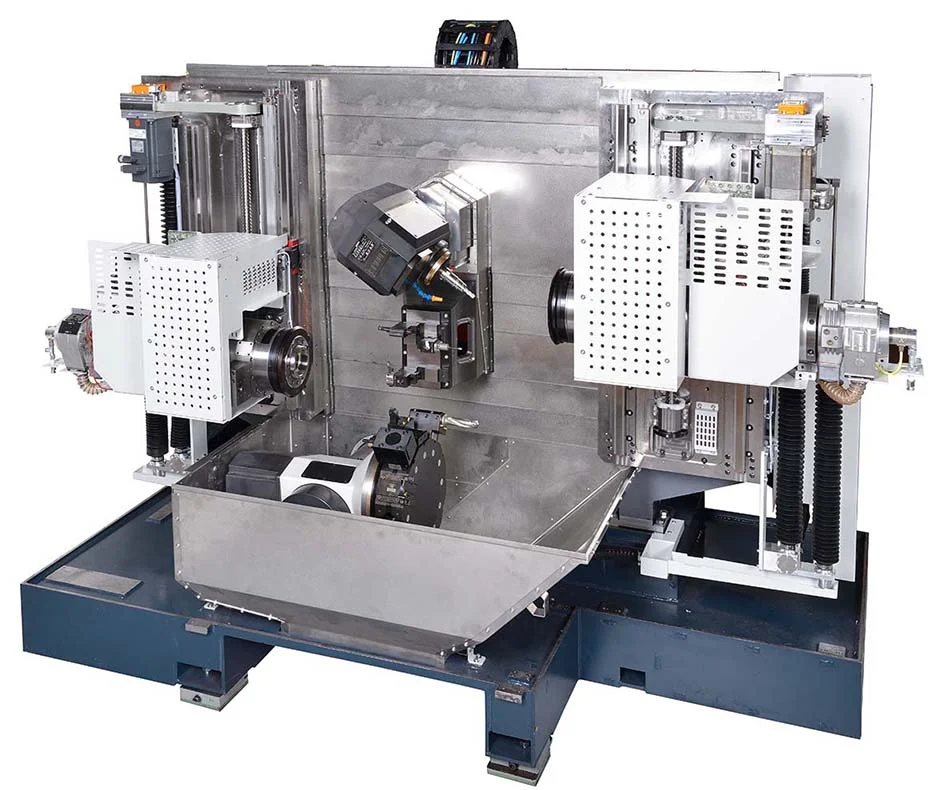
Gravity does the work in a vertical configuration. Chips fall away from the cutting zone instead of piling up around a horizontal turret and axis ways. On a machine cycling through turning, milling, and back-work in the same program, chip volume adds up fast, and a design that clears itself is often the difference between a cell that can run lights-out and one that needs someone checking on it every hour.
Footprint
The MicroTurn occupies roughly a 10′ x 10′ x 10′ envelope, which is small relative to what a comparable slant-bed mill turn with similar capability typically takes up on the floor. For a shop pricing floor space into its cost per part, that’s a real number, not a footnote. It’s the same overhead argument that applies to any machine that does more work in less square footage.
Thermal Stability
A rigid, bed-mounted linear slide, combined with linear scales on every linear and rotary axis, keeps thermal growth low through long production cycles. That matters more on a mill turn than on a general-purpose machine because the promise of the platform is submicron finishing, not just operation consolidation.
A conventional slant-bed mill turn wasn’t necessarily engineered around that tolerance target from the start. The MicroTurn was.
Access and Setup
The vertical orientation puts tooling at a more natural working height for changeovers, similar to the ergonomic case for a 90-degree slant bed on a turning center. Faster setup and less operator fatigue add up across a full shift.
What this architecture enables that a bolted-on mill turn often can’t match as cleanly: hard turning up to 60 HRC without a separate hardened-material setup, and submicron part tolerances through gang tooling in the same compact footprint whether the machine is configured for milling or for grinding. That consistency across the platform is what shows up directly in productivity per square foot of floor space, regardless of which head the application calls for.
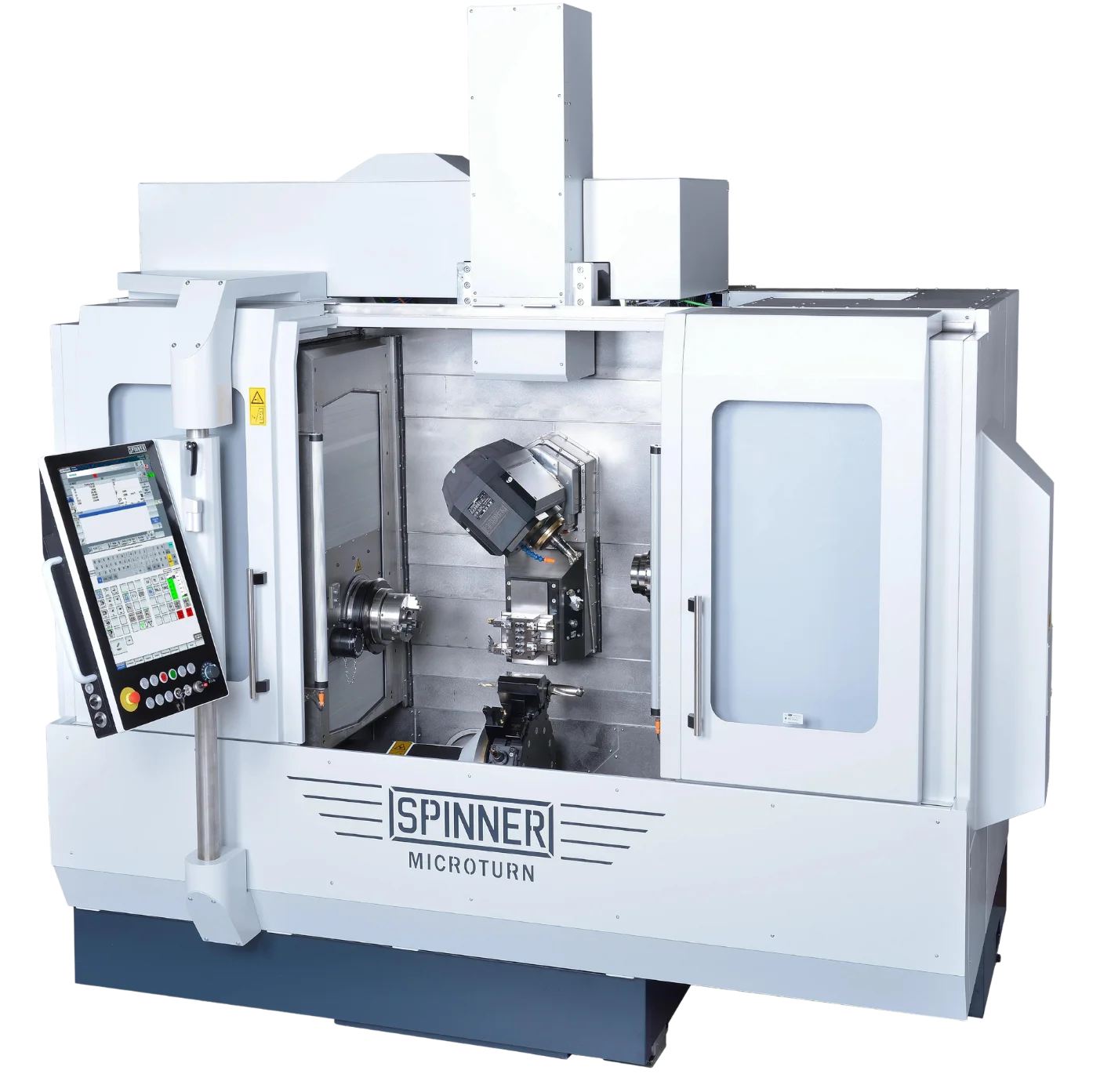
MicroTurn Machine Configurations: LT, LTB, LTBS
The MicroTurn platform scales up in three steps, and each step adds real capability rather than just a badge change.
| Configuration | Spindles | Milling Capability | Best For |
|---|---|---|---|
| MicroTurn LT | Single | Live-tool turret with Y-axis, plus gang tooling for submicron and hard turning | Turning-dominant parts needing only light drilling or milling |
| MicroTurn LTB | Single | Adds a full 5-axis milling spindle with toolchanger (up to 72 tools) and B-axis | Parts that need genuine milled features alongside turning |
| MicroTurn LTBS | Dual | Everything in the LTB, plus a second spindle for simultaneous or back-working operations | Complex parts needing back-side features finished without a second setup |
The advantage of building the line this way is that you’re not paying for capability your parts don’t need. A shop running turning-heavy parts with occasional light milling has no reason to spec a dual-spindle 5-axis machine, and a shop with complex parts needing back-working shouldn’t be stuck retrofitting a base model. The platform lets you configure the machine around the application instead of the other way around.
MicroTurn LTBS vs. MicroTurn Grind
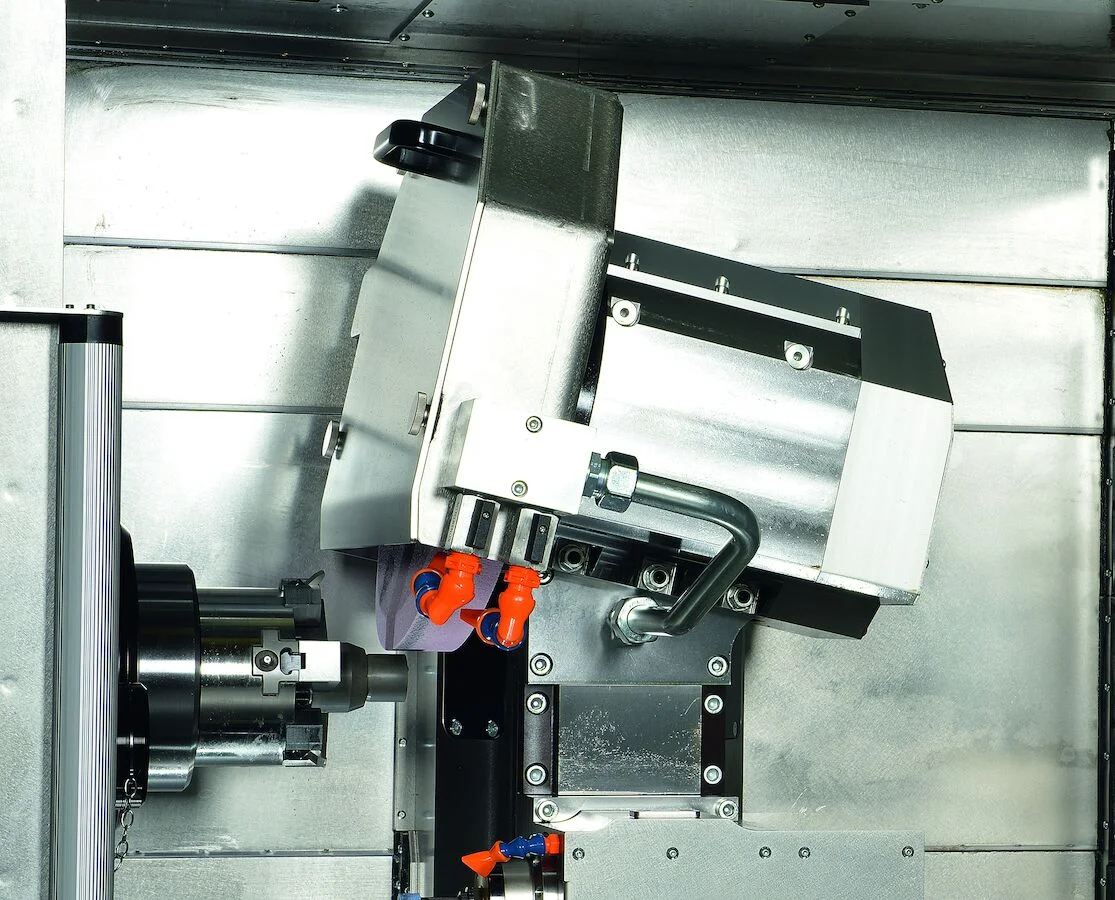
It’s worth being precise here, because the two configurations aren’t a base model and an upgrade. They’re built for different parts.
The MicroTurn LTBS pairs turning with a full 5-axis milling head, and it’s the right fit for parts that genuinely need milled features alongside turning.
The MicroTurn Grind replaces that milling head with a grinding wheel entirely. It doesn’t mill. What it does is turn a part and then grind it in the same setup, for parts where the tolerance or surface finish spec can’t be held by turning alone and the next step has traditionally been an outside grinding vendor.
This is a narrow, specialized application, not a typical mill turn job. It fits parts that are essentially turn-then-grind by nature: hardened components, bores or ODs with a finish spec tighter than turning can deliver on its own, features that need the roundness or surface quality only a grinding wheel provides.
If a part needs milled features, the Grind configuration isn’t the answer, the LTBS is. But for the parts that do fit, bringing that grinding operation in-house, in the same setup as the turning, removes an outside vendor dependency and the lead time that comes with shipping parts out and waiting for them to come back.
Automation: Robotic Load/Unload, Not Bar Feed
Automation on a mill turn machine usually means one of two things: a bar feeder for continuous bar stock, or a robot handling chucked parts one at a time. The MicroTurn’s dual opposing-spindle design is built around chucked parts, not bar stock, so bar feeding isn’t an option here.
What it does support is robotic load/unload, and Spinner’s Robobox system is built specifically for that job. A Robobox cell loads raw blanks and unloads finished parts automatically, which lets a MicroTurn run unattended through a shift or overnight the same way a bar-fed machine would, just with chucked parts instead of bar stock.
For shops evaluating the MicroTurn against a bar-fed mill turn alternative, that’s the trade-off to understand upfront: you get the compact footprint and submicron precision, and lights-out running comes through robotic load/unload rather than a bar feeder.
Workholding and CNC Programming for Mill Turn
Workholding on a mill turn machine has to account for both turning forces and milling forces acting on the same setup, which is a different problem than either operation faces alone. Collet-based workholding is common for smaller, higher-precision parts where gang tooling and submicron tolerances are the priority. Chuck-based workholding suits larger or less symmetric parts where clamping force and rigidity during milling operations matter more than ultimate precision.
Programming a mill turn machine is a meaningful step up from programming a pure lathe or pure mill, but it’s manageable. The core difference is synchronization, coordinating turning operations on one spindle with milling or back-working on a second spindle so neither axis sits idle waiting on the other. Modern CAM software handles this well, and most programmers coming from either a turning or milling background pick up the combined workflow within a reasonable timeframe, particularly with good applications support from the machine builder.
Making the ROI Case for Mill Turn
| Cost Element | Traditional (Lathe + Mill) | Mill Turn (Single Setup) |
|---|---|---|
| Machines required | 2 | 1 |
| Operators required | 1-2 | 1 |
| Floor space | Multiple machine footprints | Single compact footprint |
| Inter-operation queue time | Hours to days | Minimal to none |
| Part handling and transfer risk | Multiple events | One setup |
The numbers above are directional. Your actual savings depend on part complexity, current process, and shop rate, which is exactly why a time-and-cost study on your specific parts is worth doing before committing to a purchase.
Is Mill Turn Right for Your Application?
Ask these four questions:
- Does the part require both turning and milling features to finish complete?
- Does it currently travel to a second machine, or to an outside vendor, for milling, drilling, or grinding?
- Do you need submicron finish or hardened-material turning that would otherwise require sending the part out?
- Are you running that part, or a similar family, often enough that one dedicated cell would stay busy?
Two or more yes answers usually point to a strong mill turn application. The best next step is a time-and-cost study on your actual parts rather than working from estimates.
Frequently Asked Questions
What’s the difference between a lathe with live tooling and a true mill turn machine?
Live tooling lets a turret drill, tap, or mill light features while the part stays in the turning setup, which is useful but limited. A true mill turn machine adds Y-axis travel and a dedicated milling spindle, which opens up real off-axis milled features rather than just basic hole operations. The line matters because a lathe with live tooling can’t finish a part that needs genuine milling work.
What percentage of milled features means I need a dedicated spindle instead of live tooling?
There’s no clean percentage rule, and feature type matters more than feature count. Live tooling handles simple cross-holes and flats with loose position tolerance fine, no matter how many of them there are.
A dedicated milling spindle earns its keep when a feature needs more power or depth than a live tool station can deliver (roughly 5-10 HP on a turret versus 20-50+ HP on a dedicated spindle), a compound angle that needs true B-axis motion, or tight tolerance between a turned and milled surface. A part can be 90 percent turning and still need a dedicated spindle because of one demanding feature.
Do I need a dual-spindle machine, or is single-spindle enough for most work?
For part families with light or no back-working, single-spindle is usually enough. Dual-spindle earns its cost when the part needs simultaneous front and back operations, since transferring the part to a second spindle inside the machine eliminates a full second setup rather than just adding convenience.
How does mill turn compare to a Swiss-type machine for small precision parts?
Swiss-type machines excel on small-diameter, long, slender parts where guide bushing support prevents deflection that a conventional chuck setup can’t manage. Mill turn centers cover a broader range of part sizes and handle more complex milled features and back-working without the length-to-diameter constraints Swiss machines face.
If your parts are small-diameter with long, thin features, Swiss is worth evaluating. If they need substantial milled geometry or back-working, mill turn typically wins on flexibility.
Is grinding just an add-on to a mill turn machine?
No, and this is a common point of confusion. A configuration like the MicroTurn Grind doesn’t add grinding to a mill turn machine’s milling capability, it replaces the milling head with a grinding wheel entirely.
It’s a specialized machine for a specific kind of part: something that’s turned and then ground for final accuracy, with no milling features involved. It’s the right fit for a narrow set of applications, mainly hardened or tight-tolerance parts currently sent to an outside grinding vendor after turning, not a general-purpose mill turn upgrade.
What’s the programming learning curve coming from a standard CNC lathe?
The honest answer is there’s a real curve, but it’s manageable. The core new skill is synchronization: managing turning and milling operations, sometimes across two spindles, so no axis sits idle waiting on another. Most programmers coming from a lathe or mill background become productive on a mill turn machine within weeks, especially with good applications support from the builder.
Can one operator run a mill turn cell unattended?
Yes, and it’s one of the strongest arguments for the platform. A mill turn machine finishing a complex part in one setup, paired with automation, needs operator attention mainly at setup and material changes.
Depending on the machine, that automation might be a bar feeder for continuous bar stock or a robot handling chucked parts, like the MicroTurn’s Robobox system. Either way, it frees the operator who used to run a second-op machine to manage additional cells or handle quality work instead.